Words Clouds and Interviews’ Graphs
The following images represent both the words clouds and the networks of words derived from theinterviews conducted to lawyers and magistrates. While the words clouds consist in emphazising the importance of single words used by the legal professionals, the graphs aim to show the complexiy and the interconnections beween various aspects of their professions, highlighting the most relevant topics discussed during the interviews.
Lawyers’interviews
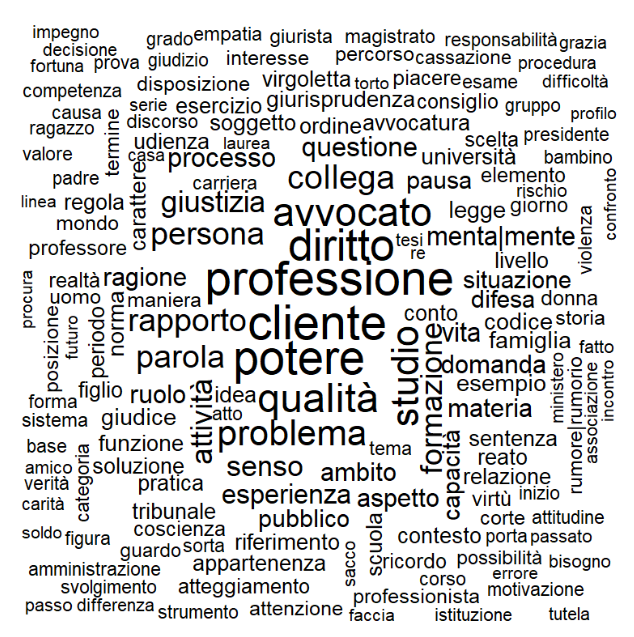
The image represents a word cloud where the most frequently occurring words are shown in proportion to their frequency of use. The most frequently occurring words are: “avvocato” (lawyer), “diritto” (law), “professione” (profession), “client” (cliente), “power” (potere).
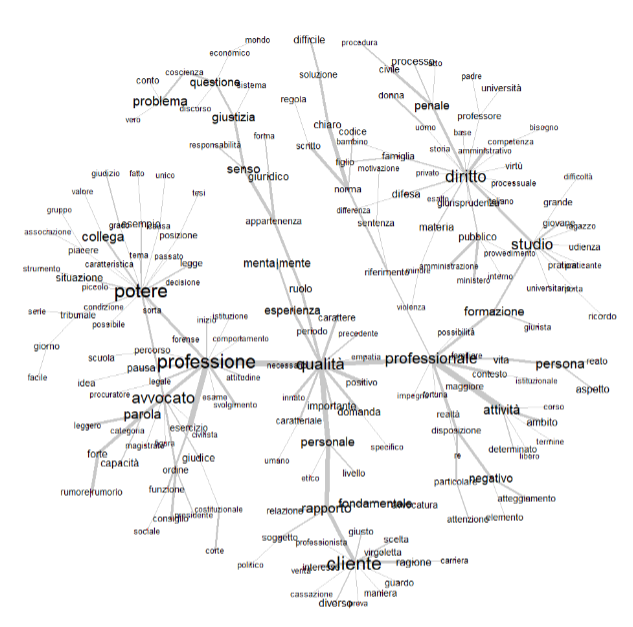
The image shows the relationships between the most frequently occurring words taken from interviews with lawyers. The image presents a network visualization and the structure is organized as a graph in which nodes represent individual words and edges represent relationships between them. The size of each node appears proportional to its frequency or centrality within the corpus, while the thickness of the connecting edges suggests the relative strength of association. The graph overall conveys a multidimensional representation of the legal profession, integrating institutional power, doctrinal knowledge, professional identity, relational ethics, and personal attributes. The density of connections among central nodes indicates a highly interconnected conceptual field, where professional practice is constructed at the intersection of law, authority, quality, and client relations.
Ethical and personal attributes are linked to central terms like “qualità” (quality),“personale” (personal), “importante” (important), “empatia” (empathy), “carattere” (character), and “livello” (level), suggesting an emphasis on personal competencies and professional virtues.
Magistrates’ interviews
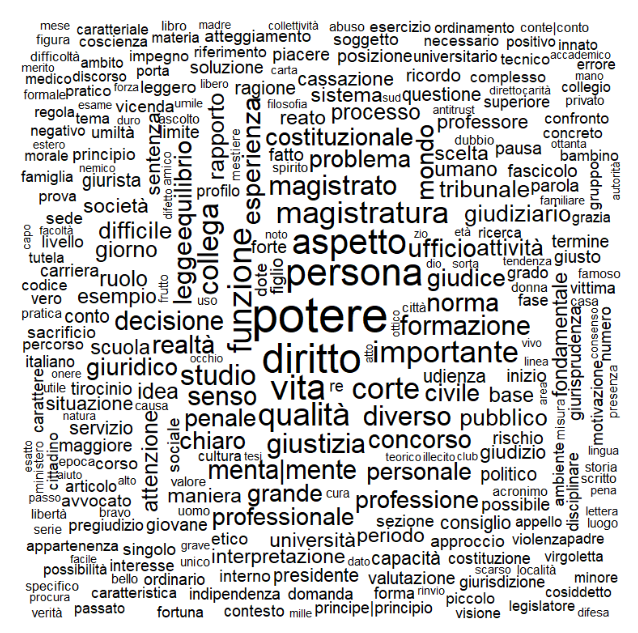
As in the case of lawyers, the image represents a word cloud where the most frequently occurring words are shown in proportion to their frequency of use. In this case the most frequently occurring words are: “potere” (power), “persona” (person), “diritto” (law).
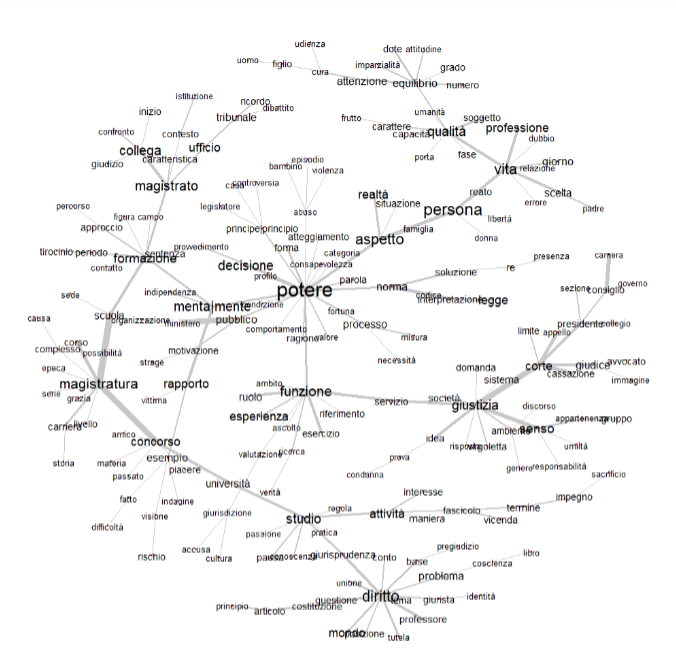
The image shows the relationships between the most frequently occurring words extracted from interviews with magistrates. As for the previous graph, each node corresponds to a specific word and the links between nodes represent their connections. The size of the nodes seems to reflect their frequency or importance within the corpus, whereas the width of the links indicates the strength of the relationships among the terms.
At the center of the graph lies “potere” (power), which functions as the principal organizing concept. It is directly connected to terms such as “decisione” (decision), “funzione” (function), “processo” (trial/process), “norma” (norm). This configuration suggests that power is framed not
merely as authority, but as an operational mechanism embedded in procedural and interpretative practices.
It is worth noting that “capacità” (capability) does not appear isolated within a purely technical cluster. Instead, it intersects with relational and evaluative words, indicating that personal abilities
are understood as context-sensitive and ethically oriented. Competence, from this perspective, is both technical and relational, where attitudes like attention, listening, balance assume a central role.
For a commented overview of questionnaires’ results, see Corso, L., Barcellona, G., Scaravilli, A. (eds.), Quali virtù per il rule of law? Prospettive di giuristi e filosofi, edited volume to be published in the Recta Ratio series, Giappichelli (forthcoming). https://www.giappichelli.it/quali-virtu-per-il-rule-of-law-9791221118322?srsltid=AfmBOorOh7EbiJh_V3ASg09dYeV33w35osvkcS86E6Uvg3QzKXr12miT.